
Stoking the Loaves: Wood Oven Breads


The wood-burning oven, a player in a former version of my Tuscan life, was used only for harvest season celebratory grape pizzas until I launched into bread experiments. Not firing it up often is detrimental to the whole process, as the oven needs to be kept sort of warmish all the time to really work well. I know this from my friend Brunero, the pizzeria owner who makes things like truffle and gorgonzola pizza and roast turkey in his wood-burning oven. He’s the one who first fired mine up for the grape pizza party. I kept my eyes open as to where to build the fire, how to use the peel, how to roll logs onto the fire at just the right angle so they actually land on the fire and stay put and burn, how to tell when it’s hot enough to bake, that sort of thing.
For my bread experiments I warmed the oven with modest flames for a few days beforehand and then on the day of spent hours stoking a roaring fire, consuming a considerable chunk of the wood pile in getting the oven up to speed. I also decided, despite any eventual negative effects on the all-important heat circulation, to build the fire up fairly close to the door where I could get to it without too much trouble. And it wasn’t even all that close. It’s a big oven, I still had to feed it by balancing pieces of wood on the mini, leaden peel (it’s small but it’s heavy) and then slowly but surely delivering them to the raging inferno. Balancing not being one of my strong points, every time a nice chunk of olive wood rolled off the peel, ashes went flying about all over what was to be the cooking surface.
I kept looking around for, as if I was going to suddenly discover one hidden in a corner somewhere, a little broom like the Sicilian bakers use. It’s a whisk of braided dwarf palm fronds and they use it because it’s particularly fire resistant. I tried just sweeping out the oven, which left too much ash on the stone baking surface. Then I tried the rag and pole method, the tried and true cleaning method of Italian women that involves swishing around a wet rag with the benefit of a pole. If you’ve been to Italy surely you’ve seen various versions of that. Down in Sicily they’re likely to be swabbing the bit of street in front of the house with the trusty rag and pole. Anyhow, it didn’t work out for me on the inside of the bread oven and I decided to just go on and ruin the mop, which I did.
The dough itself rose to perfection. I bought cake yeast and flour from the baker, and made a starter the night before leaving it in the wine cellar over night. There it developed into a perfect, spongy mass. I also left a simple flour and water mix in there to see if I could make a natural starter, thinking it would absorb plenty of the natural yeasts that are surely crawling all over the place. There was enough mold in there to choke a horse what with the variety of salamis, cheeses and that entire prosciutto, all of which had quite the moldy exterior. I even added a few drops of my own fermenting wine to the flour/water mix, alla ancient Rome, but it looked pretty much like glue 24 hours on. I have to admit to tossing it only to realize later, while speaking with an actual baker, that it was perfect and would have made a richly flavored loaf.
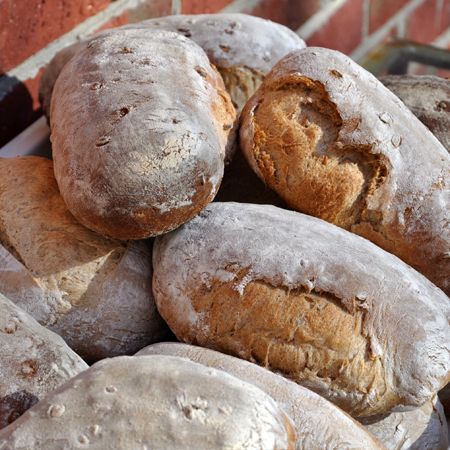
On the first go-round I stuck to the most simple of Italy’s never-ending bread array: salt-less, white flour Tuscan loaves. And they were nice enough to eat despite the oven’s having not heated up to proper temperature. Note the very Italian passive voice, it’s the oven that didn’t heat itself up properly, thereby admonishing me of any actual responsibility in the affair. The loaves didn’t puff up as much as they might have and although the tops cooked, the bottoms were sort of pasty looking. As a last resort I shifted the coals out of the way, mopped, and shifted the loaves onto the hot stone where the coals had been, which did some good although I burned a bit of one loaf to a crisp.
The second go-round in a hotter oven produced a large loaf, heart-shaped (it happened to have been San Valentino). It was excellent, dense and tasty with some nice sized holes and a velvety crumb all enveloped by the most excellent crispy crust: masterful. I am fully aware that besides my dubious mastery, the wood-burning oven is key.
Now, if you want to try your hand at it, here is the recipe for Tuscan Bread.